Requirements
NVIDIA GPU & Driver
An NVIDIA GPU with compute capability 7.5 or higher is required (Turing architecture and newer — GeForce RTX 20-series and up, Quadro RTX, Tesla T4, and all NVIDIA data-center GPUs from Turing through Blackwell).
Maxwell, Pascal, and Volta GPUs are no longer supported (e.g. GeForce GTX 900/10-series, Quadro P-series, Tesla V100). Check your card against NVIDIA's CUDA GPU compute capability list before installing.
Install an NVIDIA display driver version >= 580.65.06. Download drivers from NVIDIA.
Bundled dependencies
CUDA 13.0, TensorRT 10.13.3.9, cuDNN 9.x, NDI, Intel IPP, PyTorch, and cuVSLAM runtime libraries, as well as the Microsoft Visual C++ Redistributable and .NET 8 runtimes, are installed automatically by the Viz Object Tracker installer below. No separate downloads or manual copy steps are required.
Installer
Run the installer — it extracts its bundled files into a temporary folder.
Windows may briefly show a User Account Control prompt while the installer silently installs its bundled prerequisites (Microsoft Visual C++ Redistributable and .NET runtimes) — this is expected, allow it.
Accept the license terms to continue the installation.
Then the installer will copy all the necessary files.
Press Finish to complete installation.
Once the installation finishes, Object Tracker starts automatically, and shows up with a green light in the icon tray
 .
.The installer adds Object Tracker into the Startup Apps so it starts up automatically after logging in.
Icon Tray
Right click the icon tray to get a context menu.
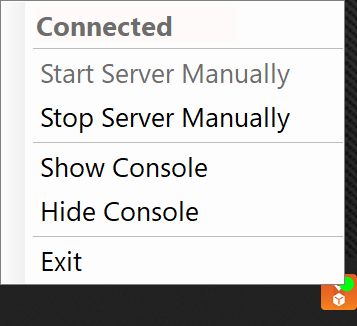
Connected/Disconnected: Indicates whether the Object Tracker is running.
Start Server Manually: Starts the service in case it has stopped.
Stop Server Manually: Stops the service.
Show Console: Visualizes the console with debugging information.
Hide Console: Hides the console.
Exit: Stops the service and closes the icon tray.
First Power up
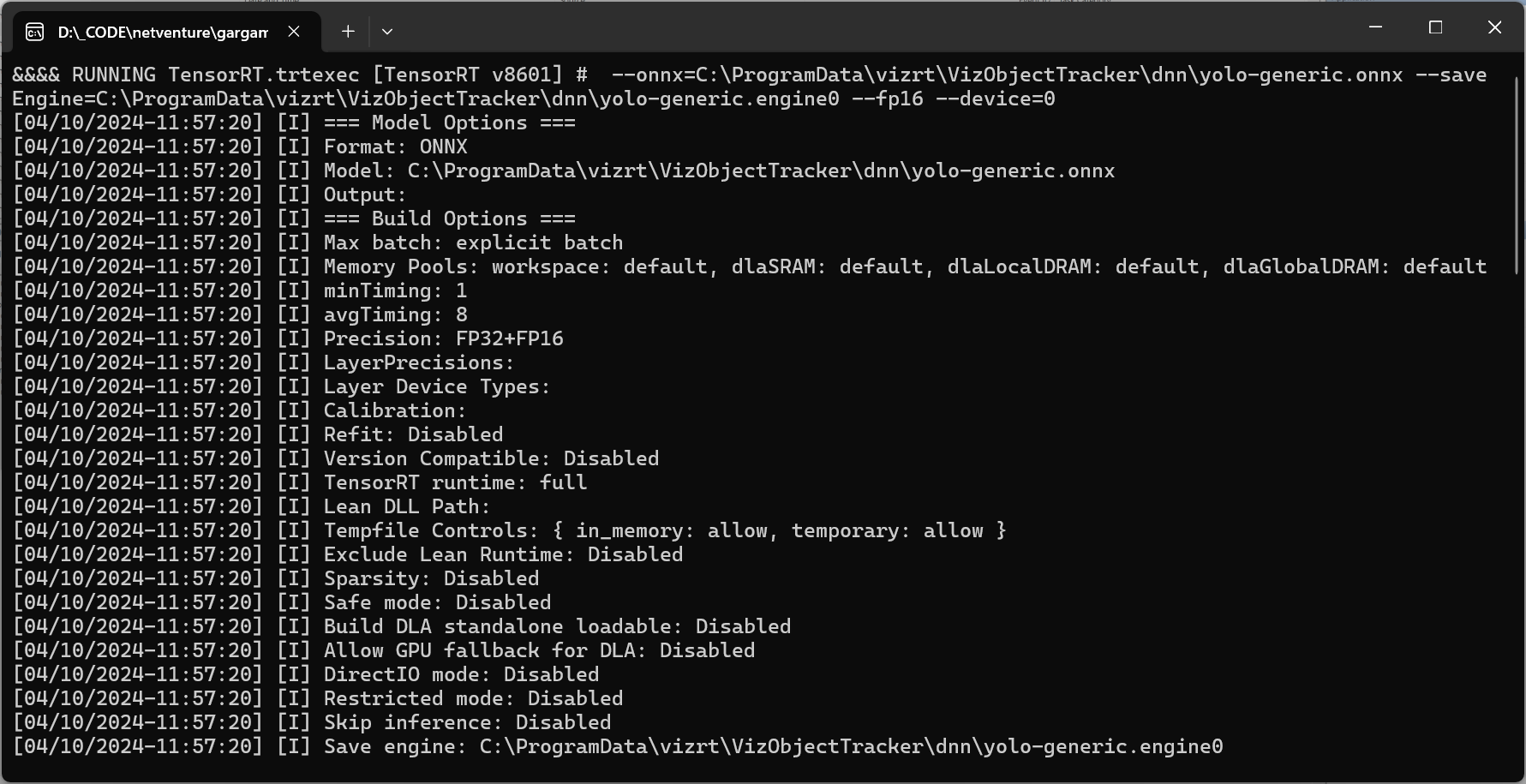
Once everything is installed properly, before starting the Object Tracker, the generic dataset model has to be compiled for every CUDA graphic card located in the workstation. This process takes few minutes for each graphic card.
Before compiling the model for a GPU, the installer waits (up to 60 seconds) for that GPU's utilization to drop to 3% or below. TensorRT's build-time tactic/kernel selection is timing-sensitive, so if something else is actively using the GPU during compilation, it can pick a meaningfully slower tactic set for that engine. While it waits, it lists which process(es) are currently using the GPU so you can close them — closing other GPU-heavy applications before this step is recommended for the best-performing engine. If the GPU is still busy after 60 seconds, compilation proceeds anyway.